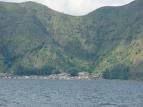
 One can access this traditional, unique and isolated Bali Aga or original Balinese village only by boat. From the village of Kedisan, beside Lake Batur at Kintamani, hire a boat for the half-hour journey. Refer to the notice board for daily rates. Untouched by modern influences, Trunyan is particularly known for its kuburan or cemetery, about 500 meters outside the village and the method of dispatching the dead. Not believing in cremation the tradition is of weathering burial. A white cloth covers the body and lengthy rituals proceed. A bamboo cage surrounds the body, which is then left to the elements.There are also a couple of traditional Bali Aga-style dwellings, and a large banyan tree, which is said to be more than 1,100 years old. At Kuban sub-village close to Trunyan is a mysterious cemetery that is separated by the lake and accessible only by boat - there is no path along the steep walls of the crater rim.
The main temple of Trunyan, Pura Pancering Jagat, is known locally as the ‘temple of the navel of the world’ and stands by an ancient banyan tree that is said to be over 1000 years old. The name of this temple is derived from the megalithic statue known as Arca Da Tonta or Ratu Gede Pusering Jagat. A major temple ceremony (odalan) takes place here annually around the full moon of October in accordance to the Balinese lunar calendar. A unique dance called the Barong Brutuk is performed on this occasion to commemorate the legendary wedding anniversary between Ratu Sakti Pancering Jagat and the patron guardian of the village Ratu Ayu Dalem Pingit.
Beyond Trunyan is another separate place known as Kuban that is also only accessible by boat as there is no pathway joining the two. Here I discovered a Pura Dalem (temple of the dead) and an adjacent cemetery that lies beneath a tree known as Taru Menyan. The people of Trunyan do not practice cremation or even bury their dead. Instead they lay a deceased body wrapped in white cloth with the head clearly visible in a bamboo cage to naturally decompose.

Culturally and ethnically outside the mainstream, Trunyan provides evidence of how Bali's earliest people lived. The inbred inhabitants are mostly fishermen, their harsh expressions mirroring a harsh life. Women wearing warm red kain pound padi in giant stone mortars. Although they plant cabbage, onions, and corn in plots near the lakeshore, the Bali Aga have no rice fields. Since ancient times they've relied on begging to supplement their meager diet. Much of the village-houses, walls, alleyways-has been cut crudely out of volcanic rock. Without trees and gardens, their homes present a bleak impression, unlike any other village on Bali. Modern Indonesia is now making heavy inroads, with the construction of new brick, concrete, and zinc-roofed buildings. Except for a massive 1,100-year-old milkwood tree in the center of the village, there's little sense any longer of Trunyan being an old village. The few traditional architectural oddities include special boys' and girls' clubhouses (bale truna and bale daha), a pavilion where married women meet (bale loh), and a great wooden ferris wheel put in motion during ceremonial occasions. The giant contraption is revolved by foot power. Trunyan's bale agung, where married men sit in council, is one of the largest traditional buildings on Bali.
A walk through the area provides glimpses of the deceased in various states of decay. Contrary to what you might think, the village is not suffocated by bad odors, because the tree emits a strong smell that overwhelms the odor of the corpses.

Tidak ada komentar:
Posting Komentar